How martial arts classes build real confidence in kids and give them practical tools to handle bullying, backed by what child development experts recommend.
Most parents have had the moment: a child comes home quieter than usual, and after a little gentle prodding, admits that someone at school has been picking on them. It is one of the hardest situations to navigate, because a parent's instinct is to fix it immediately, and there is rarely a clean fix. What actually helps, over time, is giving a child tools they can use themselves — and a growing number of parents and youth counselors point to structured martial arts training as one of the more effective options, not because it teaches kids to fight, but because of what it does for posture, composure, and self-belief long before any physical confrontation would ever happen. Programs built specifically around this idea, like Gracie Bullyproof, were designed from the ground up to address bullying rather than general fitness.
Why Confidence Matters More Than Toughness
Bullies, almost without exception, target kids who look like an easy target: kids who avoid eye contact, shrink their posture, or visibly hesitate before responding. This is not a character flaw, it is a physiological response to feeling unprepared. Martial arts training does not make a child bigger or stronger overnight, but it changes how they carry themselves, because they have practiced staying calm under pressure in a controlled setting hundreds of times before it ever matters in real life.
That difference in body language alone changes how other kids perceive them. Confident posture is one of the most consistent predictors of whether a child is targeted at all.
What a Good Anti-Bullying Program Actually Teaches
Not every martial arts class is built with bullying prevention in mind, and parents should know what to look for. A well-designed program typically covers:
De-escalation first — how to read a situation, set a verbal boundary, and walk away
before anything physical is needed
Positional control — techniques (often drawn from Brazilian jiu-jitsu) that let a smaller
child neutralize a bigger one without striking, which matters enormously for school-safety policies
Emotional regulation — breathing and composure drills that translate directly into
staying calm during a confrontation, a test, or a stressful social moment
Repetition under mild stress — practicing scenarios enough times that the response
becomes automatic rather than something the child has to think through in the moment
The Research Behind It
This is not just parenting folklore. Public health researchers have long linked structured physical activity to measurable improvements in child self-esteem and anxiety management, and anti-bullying frameworks increasingly recommend skill-building approaches rather than purely punitive ones. The U.S. government's own bullying-prevention resource, StopBullying.gov, specifically highlights confidence-building and assertiveness skills as protective factors, distinct from telling kids to simply "ignore it" or "fight back."
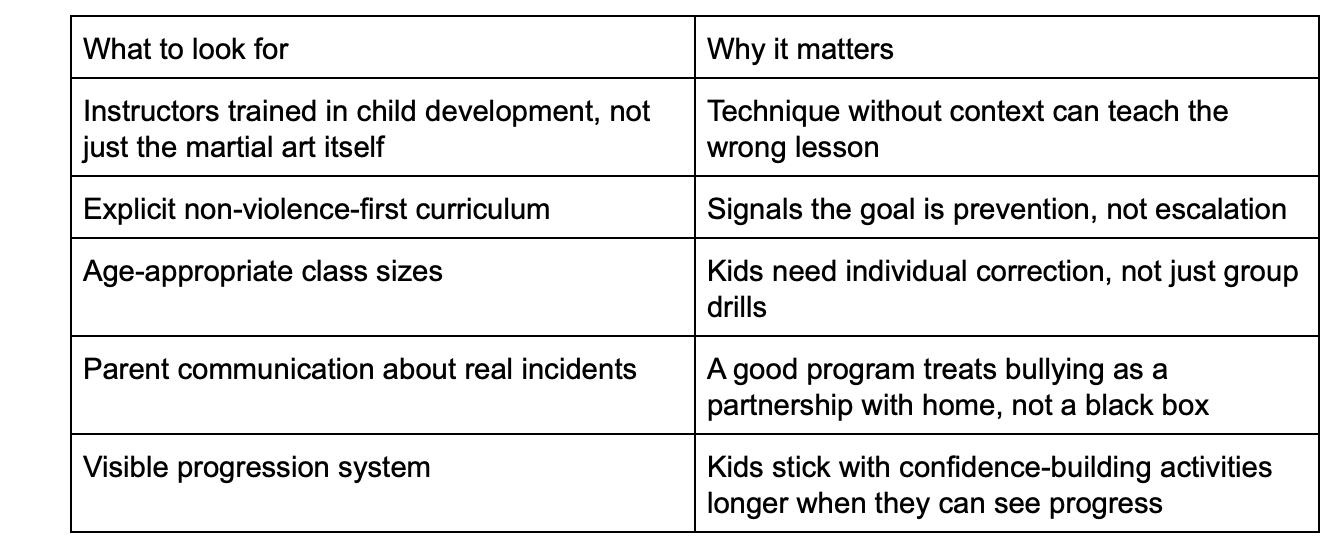
Signs a Program Is Doing This Well
A Realistic Timeline
Parents often ask how quickly they should expect to see a difference. It is rarely instant, and any program promising overnight results should be treated skeptically. A more honest picture:
1. Weeks 1 to 4 — the child is still learning basic movement and often feels self-conscious 2. Weeks 5 to 10 — noticeable improvement in posture and willingness to speak up at home 3. Month 3 onward — the confidence starts generalizing beyond the mat, showing up in how the child handles unrelated social situations, not just physical ones
Frequently Asked Questions
Does my child need to be athletic to start? No. Programs built around bullying prevention are designed for complete beginners, and the early curriculum focuses on coordination and confidence, not competition.
Is this the same as teaching kids to fight? Not in a well-run program. The explicit goal is to reduce the odds a physical confrontation happens at all, by changing how a child carries themselves and communicates boundaries.
What age should a child start? Most bullying-prevention-focused programs accept kids from around age 6, though the specific curriculum and class structure should be age-segmented.
The Bottom Line
No single activity eliminates bullying, and parents should be wary of anyone who claims it does. What structured martial arts training reliably delivers is a measurable boost in a child's composure, self-advocacy, and willingness to set a boundary, which are exactly the traits that make a child less likely to be targeted in the first place. For families dealing with an active bullying situation, pairing a program like this with open communication at home and, where needed, direct involvement from the school, gives a child the best realistic chance of resolving it.
References
StopBullying.gov, U.S. Department of Health and Human Services — Prevention at School
Centers for Disease Control and Prevention — Youth Physical Activity Guidelines
American Academy of Pediatrics — Bullying: It's Not Ok