What Alberta's July Gaming Launch Changed About Advertising in Edmonton
Alberta's regulated online gambling market opened to private operators at midnight on 13 July 2026. Twenty-two platforms went live that night, and by mid-August the number had passed twenty-seven.
The part most Edmontonians actually noticed was not the launch. It was what happened to the advertising afterwards. Licensed operators are permitted to advertise, and a market that previously carried a single government platform now carries more than two dozen brands competing for attention across streaming, radio and outdoor.
That change is worth understanding on its own terms, separately from any question about whether anyone chooses to play.
What actually changed on 13 July
Before that morning, an adult in Alberta had two routes: PlayAlberta, the government platform, or an offshore site operating with no provincial accountability. After it, the same adult had a regulated field of licensed operators.
The legal basis is the iGaming Alberta Act, which created a licensing route for private operators separate from PlayAlberta. Competition between those licensees is largely fought on promotional terms, and Bonus.com's guide to online casino bonus conditions sets out what the wagering requirements attached to those offers actually mean. The government platform was not abolished. It continues to run with commercial competition beside it, which is the same structure Ontario has used since 2022.
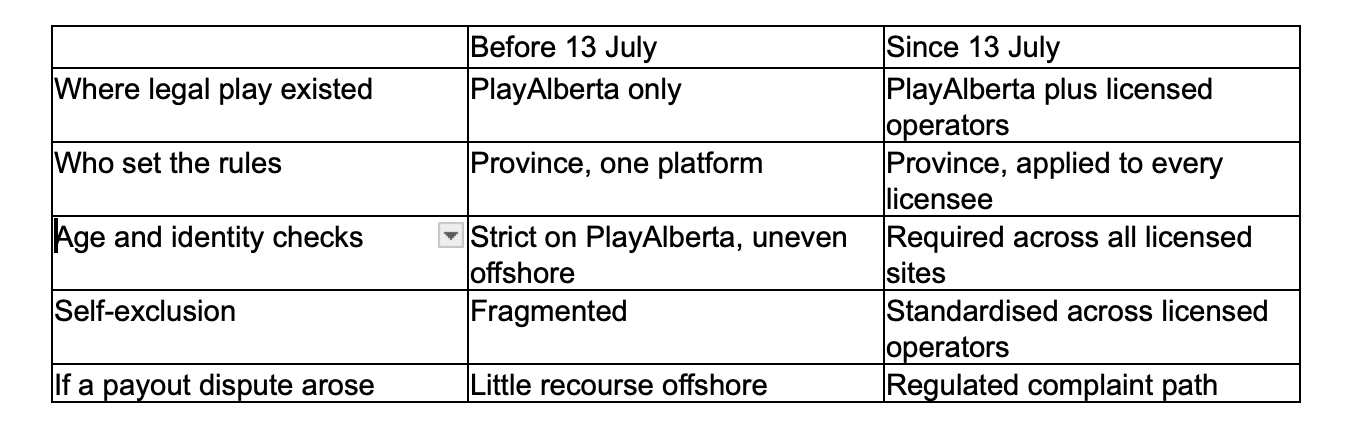
That table is a map of accountability rather than a scoreboard. The mathematical edge built into these products did not move, and nothing about licensing changes the odds of any game.
The advertising rules are stricter than most people assume
This is the part that gets least coverage and matters most to anyone concerned about who is seeing these adverts.
Alberta's rules for licensed operators prohibit advertising that targets minors or vulnerable people, and prohibit depicting minors or people who appear to be minors. Adverts may not use themes, characters or celebrities that primarily appeal to youth, unless the appearance is part of responsible-gambling messaging. Operators are also barred from advertising bonuses, credits or free bets unless a person has actively consented to direct marketing.
The province has stated that its rules prohibit operators from using professional athletes and celebrities to encourage betting. Ontario introduced an equivalent restriction on 28 February 2024, barring active and retired athletes from gambling adverts except in responsible-gambling messaging.
The province sets these out as part of its iGaming strategy. Operators are also expected to target only 18-plus audiences on social platforms, and to remove anyone registered with the centralised self-exclusion tool from marketing lists.
Why exposure is still worth watching
Rules on content are not the same as rules on volume, and this is where the honest concern sits.
A 2026 Ontario Student Drug Use and Health Survey finding reported that more than 80 per cent of students had seen or heard an online gambling advertisement in the past month, with roughly a quarter encountering them daily. That is Ontario data, from a province four years into an open market, and it is the closest available indicator of what a mature regulated market looks like from a young person's perspective.
The mechanism is not targeted advertising. It is spillover. Adverts bought against national sports broadcasts reach whoever is watching the broadcast, and a household with the game on does not filter by age. Compliant advertising that follows every content rule still arrives in a living room where someone under 18 is present.
That distinction is worth holding onto, because it explains why "the rules prohibit targeting minors" and "minors see a lot of gambling advertising" are both true at once.
Why volume is harder to regulate than content
Worth spelling out, because it is the structural reason this problem persists in every open market.
Content rules are enforceable against a single advert. A regulator can look at a creative, decide it depicts someone who appears under 18 or leans on a celebrity with youth appeal, and require it withdrawn. That is a tractable enforcement problem with a clear test.
Volume is not like that. No individual advert is at fault when twenty-seven operators each buy a compliant slot in the same broadcast. Each one follows the rules; the aggregate is what changes the environment. Regulating that would mean capping total inventory rather than policing content, which is a considerably heavier intervention and one no Canadian province has attempted.
Some jurisdictions elsewhere have gone further, with restrictions on advertising during live sport or before a watershed. Alberta has not, and neither has Ontario. Whether that changes is likely to depend on how the exposure figures develop over the next few years rather than on any argument about individual adverts.
The age line, and where it differs
Alberta's minimum gambling age is 18. Ontario's is 19, British Columbia's is 19. Licensed operators must verify age and identity at registration, and again before permitting withdrawals.
The provincial variation catches people out more than it should. An 18-year-old may lawfully hold an account in Alberta and may not in Ontario or BC, and moving between provinces does not carry the entitlement with them. Every regulated operator runs a location check before accepting a wager, combining satellite positioning, cell tower data, network information and IP address, so the account travels but the permission does not.
What the regulated market genuinely provides
Worth being accurate in both directions here, because this is routinely oversold and undersold in equal measure.
A licence delivers audited game fairness, enforced identity and age verification, mandated responsible-gambling tools including deposit limits and time reminders, a centralised self-exclusion system that applies across every licensed operator at once, and a complaints route that leads somewhere. Offshore sites offer none of that reliably, and no Alberta body will take up a file against one.
A licence does not improve anyone's odds. The house edge is built into every product on both sides of the line. Regulation governs whether you get paid and whether anyone answers when something goes wrong. It does not govern whether you win, and any framing that treats a regulated site as a better financial proposition is simply wrong.
Who this actually helps, and who it does not
The clearest beneficiary is an adult who was already playing offshore and now does so somewhere that verifies age, honours self-exclusion and answers a complaint. That is a real consumer-protection gain and it should not be dismissed.
The picture is less favourable for anyone who has struggled to keep play in check. More availability and considerably louder advertising is a harder environment, not an easier one. Guardrails are not the same as a reduction in risk, and the tools only work if someone uses them.
The practical version, for any adult in Alberta considering it: the minimum age is 18, deposit limits should be set before a first session rather than during one, any bonus should be treated as entertainment spending that may simply be lost, and the centralised self-exclusion tool exists and works across every licensed operator simultaneously.
Anyone whose play stops feeling like entertainment can contact the Alberta Health Services Addiction Helpline free and confidentially on 1-866-332-2322, at any hour.
What the next year probably looks like
Expect the operator list to move as some brands gain traction and others withdraw. Expect advertising to concentrate around football season and the holidays, which is when the inventory is most valuable.
Expect, too, continued argument about volume rather than content. Ontario's experience suggests that a market can enforce strict rules about what an advert may contain while still producing an environment where most young people report seeing gambling advertising regularly. Alberta is at the beginning of that curve, not the end of it, and the reasonable thing to watch over the next year is not the rules but the frequency.
For anyone tracking how Alberta's rules and operator list develop, Bonus.com on Facebook posts updates as the market settles.
Regulatory and survey details reflect Alberta, Ontario and provincial sources current to 28 August 2026.