Bedroom Doors: What Actually Makes a Room Quiet
The complaint is always the same, and it is never about the neighbours. It is the television in the living room, the dishwasher finishing its cycle at eleven, someone taking a call in the hallway at seven in the morning. In a house or condo where several people keep different schedules, bedroom doors do more for sleep quality than blackout curtains, white noise machines and new mattresses combined - and they are usually the one element nobody upgrades.
Where the noise actually gets in
Interior walls in most GTA homes handle sound reasonably well. The opening does not. Noise reaches a bedroom through three routes, and all three run through the door.
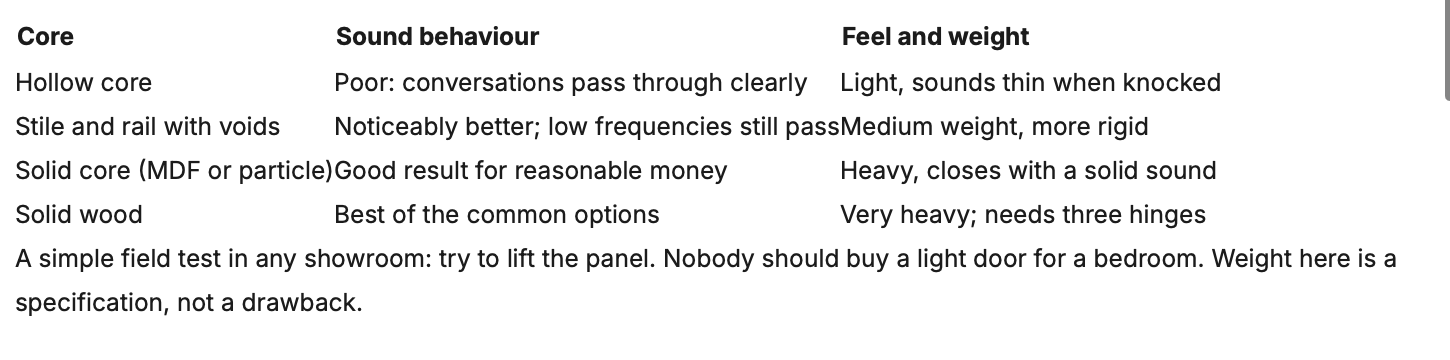
Through the panel. A hollow core slab is essentially a drum: two thin skins with a cardboard honeycomb between them. It transmits voices almost unchanged.
Around the perimeter. A three-millimetre gap on each side undoes any panel quality. Wherever air moves, sound follows.
Underneath. The standard undercut for air return is a direct channel from the hallway.
Which means the useful question is not "which door looks best" but "what is inside it and how well does it seal".
Core type: the decision that matters most
Seals, undercuts and the compromise in between
A perimeter gasket in the frame costs very little and does more than upgrading to a more expensive slab. It dampens sound in the gap and removes the slam when the door closes.
The bottom edge is harder. Many Canadian homes rely on the door undercut for return air, so sealing it completely can leave a bedroom stuffy with the door closed and the window shut. Two workable answers: an automatic drop-down seal that lowers when the door closes and retracts when it opens, or a properly sized transfer grille elsewhere in the room so the undercut is no longer doing ventilation duty.
Hardware that does not wake anyone
Magnetic latch. Instead of a metal click, the door draws closed quietly. The difference is most obvious at night when somebody comes back to the room.
Privacy lock. A bedroom lock should be a simple thumb turn with an emergency release from the outside - not a keyed lock that someone will eventually be locked out of.
Adjustable hinges. New builds settle, older homes shift with the seasons. Hinges that adjust in three planes let the seal be restored instead of replaced.
Soft-close or damper. Useful in homes with forced-air heating, where pressure differences make doors swing on their own.
Finish choices for a room seen mostly in low light
Bedrooms are used in the early morning and late evening, which changes how a finish behaves. Cool whites turn grey under warm bulbs; ivory and greige stay calm. Matte surfaces avoid the reflections that gloss picks up from a bedside lamp or a streetlight. Darker panels, often avoided elsewhere, work well here because they do not bounce hallway light back into the room.
Glazed panels are the one option to think twice about. Light passing through from a hallway is exactly what a bedroom does not need, and a solid panel is almost always the better call - which is why bedroom doors and glass doors tend to be different purchases in the same renovation.
Practical checks before ordering
Confirm the swing direction against the furniture plan. In a twelve-by-twelve room, a door opening toward the bed is a daily irritation.
Measure the opening in three places for width and height; older homes are rarely square.
Check wall thickness for jamb and extension requirements.
Decide room by room where a solid core is worth paying for - typically bedrooms and the main bathroom, not the pantry.
Ask whether a perimeter seal is included with the frame or priced separately.
Comparing it in person
No specification sheet communicates the difference between a hollow and a solid panel. Closing two doors in a row does, in about four seconds.
Trio Doors displays its collections assembled with frames and seals at the Vaughan showroom inside IMPROVE Canada, 7250 Keele Street, store #396-398, which makes that comparison possible before anything is ordered. The range spans primed, pre-painted, veneered, laminated and mirrored finishes from manufacturers such as Astori and Dooris, with handles and privacy hardware from Manital and Griffwerk in the same room - so the panel, the latch and the seal are chosen together rather than in three separate steps.
For openings that fall outside standard sizes, or for taller doors in newer condos, panels can be made to measure at the company's own factory, while common sizes are covered by the in-stock program supported by the warehouse on Wildcat Road in North York. In a renovation with trades already booked, that difference between days and weeks is worth clarifying at the start.
The short version
A bedroom needs a heavy panel, a sealed perimeter, a sensible answer at the floor and hardware that closes quietly. Style comes after that, and it costs almost nothing once the first four are settled. Start with the weight of the slab and the rest of the decision becomes straightforward.