Why Football Pitches Aren’t All the Same Size: The Rules That Let Clubs Shape Their Grass
Most fans assume every professional pitch is identical. It looks that way on TV, with the same white lines, the same penalty boxes and the same centre circle. In reality, the Laws of the Game allow a surprising amount of freedom, and football pitches come in different sizes for a reason. A few metres here or there can change how a team defends, how wide it attacks and how tired the players feel by the 80th minute.
That difference matters more than many people realise. Coaches study it, analysts factor it into match previews, and fans who follow form and team news through stats apps or platforms like Parimatch sometimes notice that certain teams play very differently at home and away. Part of the explanation can lie in the grass itself. Here’s how the rules work and where clubs can and can’t bend them.
What the Laws Say About Football Pitches
The rules for football pitches come from the International Football Association Board (IFAB), in Law 1 of the Laws of the Game. The basic requirement is simple: the touchline must be longer than the goal line. Beyond that, the ranges are wide.
For general matches, the touchline can be anywhere from 90 to 120 metres long, and the goal line from 45 to 90 metres. That means a legal pitch can, in theory, be almost twice the area of another legal pitch. For international matches the range is tighter, with touchlines between 100 and 110 metres and goal lines between 64 and 75 metres.
Crucially, the Laws let competitions set their own sizes within these limits. That’s where leagues step in.
Important. The markings inside the pitch don’t change with its size. The penalty area always extends 16.5 metres into the field and the goal area 5.5 metres, whether the pitch is huge or small.
How the Premier League Narrows the Options
The Premier League decided long ago that too much variety wasn’t a good thing. Its rulebook states that the pitch should be 105 metres long and 68 metres wide. A club can only get permission for different dimensions if it’s impossible to comply because of the way its stadium is built.
There are other rules too. Clubs have to register their pitch dimensions before the season starts and aren’t allowed to change them during the campaign. That rule exists to stop teams from shrinking or widening the pitch depending on the opponent, which some clubs were rumoured to do in the past.
Not everyone fits the standard. A few years ago, six Premier League clubs had pitches slightly smaller than 105 by 68, usually because older grounds simply didn’t have the room.
Comparison Table: Pitch Sizes at Well-Known Stadiums
Here’s how pitch sizes compare at several well-known grounds:
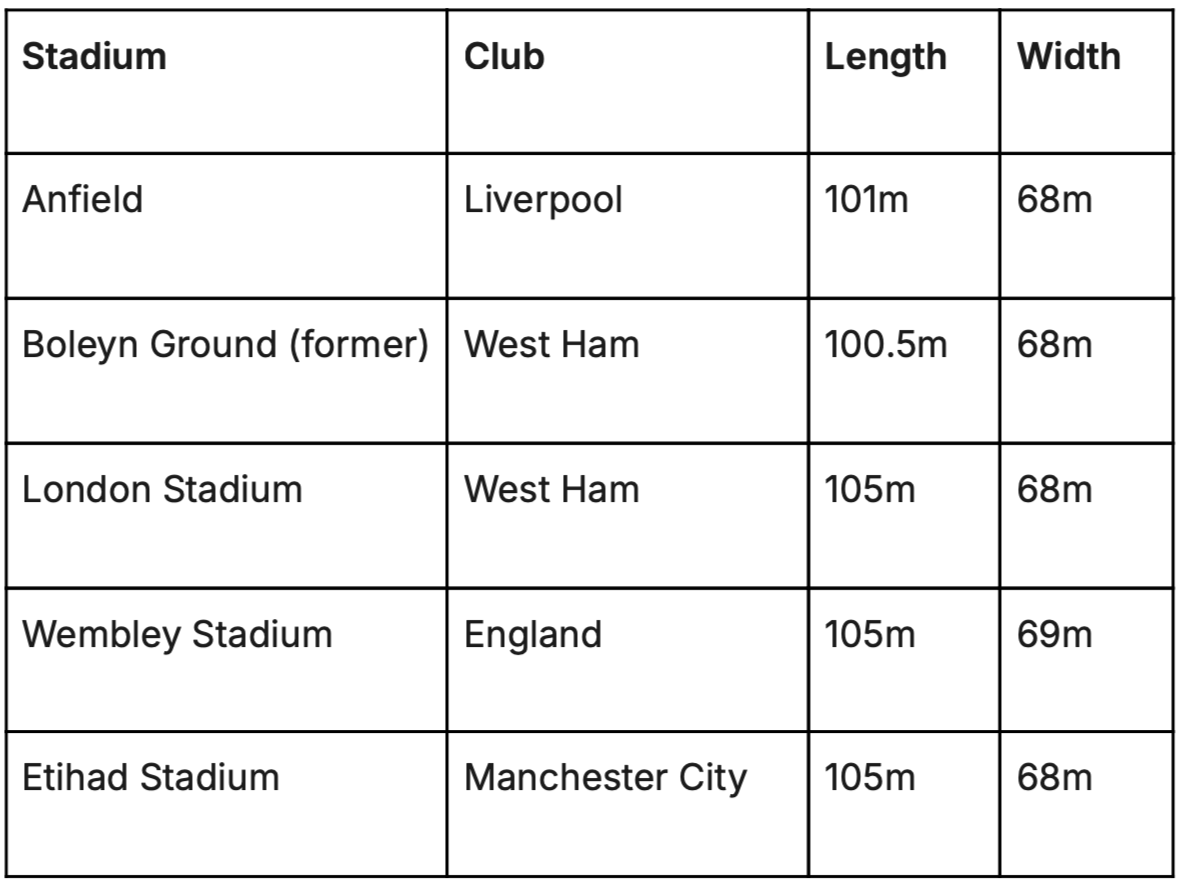
West Ham’s story is a good example. At their old home, the Boleyn Ground, the pitch measured 100.5 by 68 metres because the stadium was too tight to fit the standard length. When the club moved to the London Stadium, some fans argued the new pitch felt smaller. The club responded publicly that it was in fact the standard 105 by 68, the same size required by Premier League and UEFA rules.
Example. In the 2022/23 season, 14 of the 20 Premier League clubs used exactly the same 105 by 68 metre dimensions. The rest were close but not identical, which means visiting teams still had to adjust slightly at a handful of grounds.
Why Size Changes the Game
So why would a club care about a few metres? Because space is what football is built around. A wider pitch gives wingers more room and stretches defences. A narrower or shorter one makes the game more compact, with less space between the lines and more physical contests.
Generally speaking, here’s how coaches think about it:
Wider pitches suit teams that attack down the flanks and like to switch play.
Narrower pitches help compact, defensive sides that want to keep opponents squeezed.
Longer pitches demand more running and can tire out teams that press high.
Shorter pitches reduce the distance between penalty areas and can favour direct football.
This is exactly why leagues introduced standard sizes and banned changes mid-season. Without those rules, a club could, in theory, redesign its pitch every week to suit its own style and frustrate the next visitor.
Sports Technology and Digital Platforms
Modern sports technology has made pitch differences easier to measure and analyse. Tracking systems record where every player runs, so analysts can see how much space a team uses on a wide pitch compared with a tight one. Clubs use this data to prepare for specific away grounds, even down to rehearsing on a training pitch marked out to the same size.
The convenience of digital platforms has brought this kind of insight to fans as well. Home and away records are easy to compare on Flashscore and Sofascore, and some analysts look at Oddsportal’s odds history to see whether markets treat certain grounds as especially tough for visitors. Pitch size is never the whole story, but it’s one of the details that helps explain why some teams are so strong at home.
Expert tip. Analysts who study home advantage suggest looking at pitch size together with other factors, like travel distance, crowd noise and the condition of the grass. A small pitch alone rarely explains a team’s home record, but combined with a style built around it, it can make a real difference.
Questions and Answers
Can a club make its pitch smaller to beat a specific opponent?
In the Premier League, no. Dimensions must be registered before the season and can’t be changed during it.
Why are some old stadiums smaller?
Usually because the stands were built close to the pitch long before modern standards existed. Expanding the grass would mean rebuilding parts of the stadium.
Are World Cup and international pitches all the same size?
Not exactly, but they must stay within the tighter international range set by IFAB, so the differences are smaller than in club football.
So the next time a team looks strangely uncomfortable at an away ground, it might be worth looking down at the grass. Those few extra or missing metres are perfectly legal, and every coach knows they can matter.